Monday, July 26, 2010

Crisis Investing: Bullworthy Talks with Leslie Kessler, CEO of PureSafe

As we've seen all too much this year alone, natural and man-made disasters have exposed drinking resources in those stricken communities to bacteriological and chemical contamination, making a once abundant clean drinking water source ineffectual in the greatest times of need. Leslie Kessler and I spoke on many different historical examples of catastrophes whose immediate first response relief has been swift and passionate, but not necessarily efficient as civil unrest and desperation threatened the prosperity of the relief efforts because of a prolonged lack to basic survival resources.

Ms. Kessler is the chief executive officer of PureSafe Water Systems, Inc., a company that has committed to developing PureSafe patented technology to provide purified drinking water to disaster response teams using a mobile unit specifically designed for rapid deployment worldwide. The unit can siphon water from any source albeit a lake, swimming pool, flood site, pumping it through the non-specific contaminant purification system- meaning it can decontaminate any and every strain of bacteria or pollutant with no need to test the water supply first for safety. The output takes only thirty minutes and can supply up to thirty thousand gallons of water a day, enough to serve forty-five thousand thirsty survivors and victims’ in portable bottles or bags onboard the unit.

PureSafe is considered a game changer among the disaster relief community that includes the government analysts testing the prototypes. While disaster relief is a highly collaborative effort among citizens and governments to suppress the damage and deliver resources and aid during an emergency in an efficient and well-organized fashion, the fundamental problem lies in distribution and the lack of preparedness protocol in public and private entities that are overwhelmed during these kinds of crisis (think of a hospital, for example). Take Hurricane Katrina as a practical model. The machine could have been air-lifted on a roof of by the stadium, connected it to contaminated flood water, and distribute it to the suffering people accordingly.

The company is currently undergoing government approval testing and in that effort, has hired on Underwriters Laboratories to help evaluate the electrical safety and performance of PureSafe’s First Response Water System functioning prototype. On today’s agenda is assessment of the uplift capabilities of the machine by crane.

The functions are simple enough so that the end-user only has to turn on the failsafe machine. Buyers of the mobile units (equipment with heavy-duty wheels built for abusive terrain and a helicopter-lift positioned onto the frame) are from the public and private sector and will include local, state, and federal agencies and departments including FEMA; hospitals and universities; the military, national guard and Homeland Security; hotels and many, many more national and international organizations that have interests in disaster response preparedness. The machines can be bought outright with warranties, leased, or rented with PureSafe providing on location support and staffing; towns and cities can also pool money together to buy one machine to share.

Ms. Kessler came into PureSafe in 2007 and immediately recognized that the existing technology was not fitting the needs of those demanding the kind of solutions the company was in the process of creating and subsequently, they started all over. They realized no company was totally focusing itself in the disaster response area that concerns water distribution while recent events have emphasized, now more than ever, that preparedness is the key – what if there’s an interruption in the water supply?

“It’s a great decision to be dealing with something that can make a difference and save people’s lives, and still be a very profitable company” said Ms. Kessler.

They’ve been attending conventions to network with potential buyers and investors this year. The company’s presentations have been extremely impressive: PureSafe is fulfilling a whitespace by providing a simple water purification service that can deliver potable water to thousands with the flip on an “on” switch. Ms. Kessler didn’t want to give information that has yet to be disseminated, but she did give a one-word response to questions concerning this year’s corporate performance that gives all the guidance shareholders need to hear: revenue.

Ms. Kessler confidently asserted that yes, in fact revenue will be booked this fiscal year and sales will be made. In July, the company will be presenting at a fire expo show with representatives from all over the Eastern seaboard that will offer major exposure for the PureSafe First Response Water System. The business structure is in place and the newly appointed board of directors is deeply experienced, knowledgeable, and very active. The workload and margins are in place and favorable. Finally, the need of the products are there, so what comes next, I asked her? It’s time to start selling inventory.

Here are some interesting links from PureSafe Water Systems:

·         Water Purification Overview – from the website

·         The Water Crisis Wiki – from the website

·         Hottest Commodity to Invest In – from the website

·         Water: Cycle of Life – PDF research from Leavitt Capital Management

Disclaimer I have not been compensated or paid by Puresafe Water Systems or their affiliates in stock, cash, or by any other means. Further, the author of this post nor his affiliates own stock or interest in this featured company.

For comments or questions please contact Tom Copeland from the contact page.

Posted via email from bullworthy's posterous

Labels: , , , , , , , , , , , , , , , ,

Tuesday, July 13, 2010

The End of BP: Bullworthy Sits Down With John DiBella, The COO of Enviro Voraxial Technologies

“How long will you be down there for?” I asked John, between sips of coffee. We had just started talking. “As long as we have to be” he responded with authentic austerity.

Within the oil industry, there is a market that a small South Florida company with a proven technology is perusing called “produced water”. For every one barrel of oil extracted and produced from underground wells here in the U.S., up to ten barrels of water is extracted. This water needs to be treated and purified of its contaminants before it is released back into the environment. Just how much water needs to be separated and then produced by these oil explorers? To answer that, you’ll need to consider that more water is produced in one year from oil companies than the amount of water that spills over the Niagara Falls in nine straight days.

Researching companies that are positioned for results in the gulf spill disaster zone there are a few opportunistic publically-traded companies that highlight the skills needed. But the problem, from the day the Deepwater Horizon rig exploded in late April to today has been a severe lack in efficiency – getting more done with less.

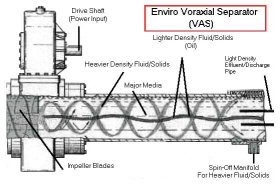
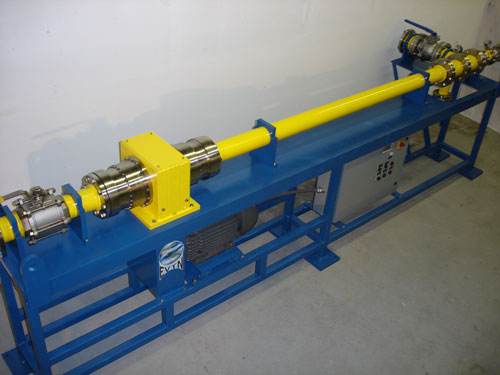
Enviro Voraxial is one of the companies meeting the need for efficiency. When I spoke with the company’s chief operating officer John A. DiBella, he was in the Gulf Panhandle meeting with local communities, authorities, and oil spill clean-up officials to discuss their technology and demonstrate the oily-water separator his family and him had built an entire company around called The Voraxial Separator. The separation machinery comes in a series of scalable sizes that are all designed to treat a range of wastewater flow rates and volumes; the Voraxial is arguably the world’s most efficient technology for high volume, bulk separation of fluids such as oil and water.

It’s clear that BP was not equipped to handle this kind of spill, but Mr. DiBella is happy to offer up that the oil company has been responsive in their efforts to locate, test, approve and acquire technologies that can help manage the enormous clean-up effort that lies ahead. In our conversation, Mr. DiBella did confirm that BP is reviewing the Voraxial separators and that Enviro was now one of 60K original clean-up assistance applicants, and then whittled them down to 250-500 closely considered candidates the oil company would be in discussions with.

And that’s the theme Mr.DiBella and I agreed should be emphasized: efficiency. The Voraxial is a proven technology that has generated revenue for the company as a diversified machine coming in four sizes: the Voraxial 1000, the Voraxial 2000, Voraxial 4000, and Voraxial 8000, all designed to handle different volumes of fluid efficiently and cost-effectively while using less space and energy than other technologies. Customers include the U.S. Navy and the State of Alaska (both have issued Letters of Endorsement to Enviro Voraxial that can be found on the company’s website here), and other major, worldwide energy exploration and oil and gas drilling companies.

I asked Mr. DiBella to compare the Voraxial technology to some other high-profile competitors. One of them is a company called Ocean Therapy Solutions that offers an oil and water separator centrifuge developed with financial backing from actor and enviro-activist Kevin Costner. Politely, Mr. DiBella began by acknowledging that any separation technology that can be used should be used because this Gulf oil spill is such a grand disaster.

“It’s great that everyone is trying” he said, before going on to explain that Ocean Therapies separator maxes out at around 150-200 gallons per minute of separating power (about 5,500 barrels per day), while the Voraxial 4000 does over two and a half times the volume of Costner’s machine at fraction of the cost (about 40% the cost), weight, energy, and space. Finally, the Voraxial 8000 does about 25 times the volume of Ocean Therapies largest unit at about 3 times the cost.

Mr. DiBella was confident in the company’s discussions with BP and other Gulf officials in the benefits that the Voraxial technology can bring to all parties involved in the clean-up effort. “BP has been responsive” he said, before going on to explain how Enviro is positioned to not only properly deploy its units in a timely manner and contribute to the Gulf clean-up effort but at the same time maintain as a small company whose technology can be used in a multitude of other functions. The company is currently pursuing many projects in the refinery, tar sands and produced water industries.

Mr. DiBella has also forwarded on to me a letter he received from a fuel division manager from the U.S. Navy. Although the material was confidential and quotes were not available at the time of this publishing, it was well within the manager’s opinion that deployment of the Voraxial would reduce, by large margins the damage done t the Gulf and recover a far greater amount of hydrocarbons that have been released in the Gulf. The letter also went on to praise the technologies efficiency and conceded that the machine is so powerful, spills of any magnitude could be dealt with in the future.

I had also asked about the conditions of the fundamental capital structure of the company – specifically, cash flow and long-term debt. “You have a small company with new technologies working with some of the largest companies in the world with a clean balance sheet and at a time when our product is needed so desperately” Mr. DiBella said, “we moved this company to a debt-free position and we believe the shareholders will be rewarded”.

The debt-load he is talking about shedding is the largest long-term liability on the balance sheet, accrued salaries to executives, which was converted into stock options in the beginning of June. “The officers are not here to draw a salary” Mr. DiBella concluded just before he had to hang up, “we’re here to build a business and in doing so, benefit from the appreciation of our share price”.

As always, feel free to contact me with questions, comments, or concerns, or suggest another CEO or company to interview at Tom@bullworthy.com.

DISCLAIMER: I have not been compensated in any way, shape, or form by Enviro Voraxial, John DiBella, or any of their affiliates or third-parties.

Labels: , , , , , , , , , , , , ,

Saturday, July 3, 2010

Earning Their Copper: Penny Stocks That Are Actually Worth the Pennies


Originally posted on Bullworthy.com.
June 27, 2010

Successful first-time investing is all about learning as much as you can and then applying that knowledge with discipline and practicality. And while that sometimes isn’t even half the battle you’ll likely face ahead, it is probably the first step and will soon be your golden rule if you ignore it and lost money on your first trades. Investing with discipline and practicality means you’re buying what you know, when you know it, and at a price and value that you understand.

Is that too much to swallow in one sentence? I know it probably is, but you’ll have to get used to it. Let’s take this one step at a time and use (what seems to be, at least) a common first-time investors Holy Grail: the penny stock.

A penny stock has undergone many definitions among traders and no one description seems to hold any more validity than the other. Some say a penny stock is any publically-traded stock that trades for under five bucks a share, while other insist trading under a dollar a share is the mandatory criterion. I have to agree with the former argument; when deep recessions hit and stocks tank, many times it’s because one rotten apple spoils the whole fruit basket because even the good apples are considered tainted (consider the big banks of the 2008 financial crisis: Lehman Brothers and Bear Stearns who dramatically failed and brought down with them some smaller banks and thrifts that had no exposure to mortgage lending and investments and therefore weren’t as vulnerable but their shares plunged anyway). In medicine, and as of recent popularity in business and finance, this foul, bad reputation is referred to as “contagion”. My point is this: sometimes a stock trades below five bucks a share without truly being worth anywhere near that little amount when it’s really not the company’s performance at fault, and they shouldn’t be classified as a penny stock.

Another important criterion a publically-traded company must meet with the penny stock label accurately is that it’s traded “over-the-counter” or OTC on obscure, unregulated stock exchanges that are rife with ambiguity and unsureties. The two most major exchanges in which penny stocks are traded are Over the Counter Bulletin Boards (OTCBB) and Pink Sheets. Here’s the difference between the two and after you read you’ll understand why your knowledge and discipline will be so important when deciding whether or not to buy a penny stock. OTCBB is an exchange in which regulation occurs (companies are required to report financial documents, statements, and changes to the SEC and be made available to the public at all times) and typically they feature companies of all sizes who a) don’t meet the listing requirements of major exchanges, including but not limited to a certain stock price or shares outstanding and free trading; or b) are gearing up for major exchange listing.

The Pink Sheets by stark contrast lists companies who are not required to file any public documentation and are under no obligation of regulation. For all the shareholder knows, a Pink Sheets company could be one big Nairobian credit card and identity theft scam (sorry Africa, I’m just so damn tied of those emails.)

Know what it is you’re trading. Enough said about discipline for now.

Practicality means doing some homework. If you’ve found a penny stock company that you think has a unique idea and could gain some attention, do some homework! These are publically-traded companies; that means any and all information (within reason, and after its public release of course) is available for you to know.

The majority of penny stock companies are new and small companies that have a ton of debt and not much revenue because there are in that start-up phase. So by that very nature, their share prices tend to be very volatile and don’t trade very often, meaning that if a big number of shares traded in a transaction one day in relation to how many shares are outstanding and available to purchase, there is a huge price swing whether it be up or down. Another investor buying ten thousand shares of a fifteen cent stock could send the share price up five hundred percent in a day (I’ll talk more about why penny stocks move up and down and the factors that contribute to those swings in a later post next week that includes why they can also be dangerous and unforgiving).

Expecting a four-thousand percent return on a penny stock you just read about on a YahooFinance bulletin board? Great! Let me know about it, so I can avoid buying it.

Here’s the bottom line. If you found a penny stock you really want to buy because you think it could explode, then stop for a second and consider this: is there really anything interesting about this company? Where’s the story and where is the proof? If you can’t come up with much, it’s hyped. Here’s an example of an interesting company who’s executive board I recently met and talked to.

Janel World Trade* has been a logistics and transportation services company since the 1970’s, shipping all over the world for its clients and has gained exceptional accreditation in its business, most notably into China. In 2007, an environmental organization approached Janel to help them ship six hundred containers to a heavily polluted and contaminated lake in a Chinese providence called Lake Tai, a huge body of water that supplied water to millions of people in many towns and two major cities: Shanghai and Wuxi. The containers held an anti algaecide solution called Clear Blue 104 the environmentalists had been contracted to distribute but were having issues clearing the requisite permits with the local Chinese authorities. Soon, the group had lost the contract to deliver Clear Blue, creating an opportunity for Janel to step in and take over by using their government contacts, knowledge, and experience. The company eventually landed a United States Trade Authority grant to test the solution in live lake conditions, a grant from a U.S. government agency that obviously has big interests in building trade around China. The initial testing has gone well and the next step is to actually implement the solution into Lake Tai. Should this all go according to Janel’s plan, there are hundreds of other lakes (and millions more dollars that will be committed to Janel) that can be taken advantage of, brining in a whole new vertical business to the company’s corporate and operational structure and new streams of dependable, high profit margin revenue.

And what if Janel does not get follow on contracts immediately? Because Janel is such an unknown and under followed company, there has been no value placed on the potential for large high profit contracts in the water pollution remediation sector. Janel, which did $71 million in logistics business last year, is trading at a very low market capitalization of $8.8 million (remember that “market cap” is calculated by taking the amount of shares outstanding (available) and multiplying that by the stock price – loosely defined, its a way to value a companies worth). When Janel gets noticed by more investors, this valuation could easily rise to a more reasonable multiple of sales. In the second quarter of 2010, Janel announced record-high revenue increases of about twelve percent at $20 million dollars in only three months. Janel’s stock trades under the symbol JLWT for just $.40 per share.

Price-to-sales is another fundamental business valuation (PSR) that pegs a stock to it’s performance history or to that of other stocks. PSR is calculated by dividing the share price by the revenue per share. Most small, un-traded, and unnoticed stocks like Janel have little or no revenue, much less $71 million.

So what about Janel? IT’s tremendously low; in fact a PSR of just one times sales, a modest estimation, would put JLWT (on last year’s revenues and no contribution from Chinese environmental contracts) at a price of $2.00/share. Now there is a penny stock worth its copper.

As always, post your comments, questions or concerns or email tom@bullworthy.com.

*I have received absolutely no cash or any form of compensation from Janel World Trade before, during, or after writing this article.

Labels: